
 Test and Balance (TAB) and Commissioning (Cx) are two of the most critical processes during building construction or renovation, and these services go hand in hand when it comes to finalizing mechanical systems. However, both are often overlooked by owners, general contractors, and subcontractors and are frequently treated as little more than a checkbox required to obtain a Certificate of Occupancy. This mindset has led to numerous issues and schedule delays over the years. Throughout this article, we will discuss the relationship between TAB and commissioning and outline steps the commissioning provider and construction team can take to ensure the delivery of a TAB-ready system and a smoother transition from TAB to commissioning.
When involved early enough, the Commissioning Provider (CxP) can begin planning for the final stages of the project and apply lessons learned from past experience to raise questions or provide feedback that may impact the TAB or commissioning processes within the Owner’s Project Requirements (OPR) and Basis of Design (BOD). During this phase, it is important to address foundational questions such as which systems are included in the project, whether a building automation system will be provided, who is responsible for the controls scope, how spaces are classified, and what the desired space conditions are. These and other high-level questions help the team begin thinking about effective TAB-to-Cx integration.
Once the OPR and BOD are established and design development begins, the project enters the critical design review phase. At this point, the CxP should review sequences of operation and carefully examine floor plans to ensure all equipment and components necessary for TAB are properly identified. Reviewing balancing damper locations, thermostat placement, terminal unit access, and Pete’s port locations is especially important. These details are easy to overlook and, if missed, can create significant obstacles during the balancing process.
After the design is finalized and drawings are issued for construction, submittal review becomes the next major milestone in the TAB/Cx relationship. It is imperative that the CxP review all VFD, motor, and fan submittals to verify that the equipment can achieve the required design airflows and waterflows. BAS product data is also critical during this phase. The CxP should confirm that all control devices are accounted for and properly sized to ensure accurate measurements needed for balancing.
Once submittals are approved and equipment installation begins, the construction phase becomes the most important point of crossover between TAB and commissioning. The CxP is responsible for issuing pre-functional checklists, which, when implemented effectively, can serve as TAB readiness checklists. While obtaining timely completion of these checklists can be challenging, they should accurately reflect the current state of field installation. When checklists are fully completed, it should indicate that mechanical startup is complete and BAS startup and graphics integration have been finalized. If coordination between the CxP and TAB contractor is successful, the building should be operating automatically through the BAS by the time TAB begins, minimizing downtime and inefficiencies.
In some cases, project specifications require the CxP to verify TAB reports and observe TAB activities in the field. This effort should be coordinated with all relevant parties to reduce confusion. A common best practice is to observe at least one of each equipment type to confirm proper balancing procedures and documentation. While this is often a formality, any questions should be addressed directly with the TAB contractor during site visits. All members of the construction team, including TAB and commissioning providers, share the same goal of delivering a fully operational building to the Owner. Transparency between trades is key to achieving this objective.
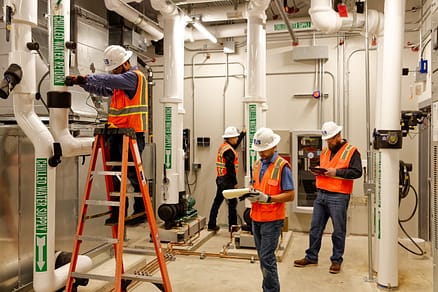
TAB contractors typically submit a preliminary TAB report for review by the CxP. The report is evaluated to ensure all required data specified in the contract documents is included. Once approved by the project engineer and CxP, system commissioning can proceed. During this phase, the CxP may reach out to the TAB contractor to clarify setpoints or investigate any discrepancies identified during testing.
Ultimately, transparency and collaboration are the foundation of a successful construction project. When TAB contractors and CxPs apply best practices throughout each project phase and maintain open communication, they significantly reduce stress and inefficiencies for all parties involved. By keeping the project’s end goal in focus, TAB and commissioning professionals can work together to deliver systems that perform as intended for the Owner.