
By Jason Hauska
So, your next healthcare project includes patient isolation rooms, including a new isolation exhaust system for the associated rooms. The system consists of two exhaust fans, each with their own variable frequency drive and motorized isolation damper. How should the fan(s)/system operate? Should they operate in a lead/lag manor, one-at-a-time, or parallel, and operate together? How were the fans selected to operate? How critical is the failure/recovery time? Let me share a few experiences on projects that have since led me to ask for clarifications on all these questions early in the process.
The first example is just as described above: we had a constant-volume exhaust system, serving patient isolation rooms (no air terminal units). The sequence called for single-fan operation: open isolation damper of lead fan, enable variable frequency drive (VFD), ramp to predetermined speed (by Test and Balance). If fan goes into alarm, disable lead fan, close lead fan isolation damper, open lag fan isolation damper, enable lag fan. The first problem we ran into was in single-fan operation, we could barely achieve our required exhaust airflow. Though not a “deficiency”, we also had a concern that there was no schedule/plan to rotate to the lag fan, which could be an issue for a belt-drive fan to sit idle, then have failed bearings/belts when needed to run. The final concern was related to sound: the patient rooms directly beneath the exhaust fans complained about the sound associated with the fan(s) running at 100% on the room above. After an acoustician was involved, we suggested, “Can we try running both lead/lag fan together, determine what speed is needed to maintain our required airflow, and see if our sound improves?”. Once agreed, we were able to determine that, in this particular arrangement, we could achieve our total required airflow with each fan at approximately 75% and our sound levels dropped to an acceptable level. Furthermore, the control sequence was simply modified to operate both fans together and, if one fan failed, isolate the failed fan and ramp the lead fan to 100%. This also meant that the failure/recovery time was minimal, compared to the previous arrangement of disabling/isolated/enabling.
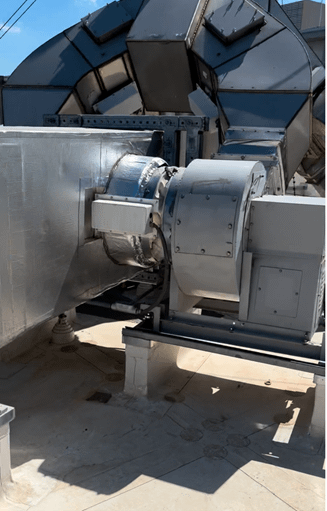
On the next project, armed with the results from the project above, we felt confident in reviewing the project documents and seeing dual-fan operation that it would be simple. However, this system utilized pressure-independent air terminal units, and the fans had a much different operational curve / much different static pressure requirements. Once all the associated air terminal units were calibrated, and the static pressure setpoint established, we tested the fan performance, first individually, then as a pair. Testing indicated that for this arrangement we required approximately 95% fan speed for a single fan operation, and 90% fan speed for each fan when operating together. What changed? Why is this arrangement so inefficient? Once we plotted the test data on the fan curve(s), we could see that between the static pressure loss on the system (especially at the fan connections), and the fan selection, the dual fan operation was very inefficient. The fans did serve critical isolation areas, and the fast failure recovery that the dual fan operation allows outweighed the inefficiencies.
Figure 1: Dual Fans
 In conclusion, on your next project with dual fans, I suggest you consider spending a little extra time as early on the project as possible to clarify:
- What is the intended “normal” operation?
- Single fan?
- What causes the second fan to enable?
- Lead fan failure?
- Failure to meet setpoint?
- Do we rotate to the second fan regularly?
- What causes the second fan to enable?
- Dual fan?
- Do both fans control to the same setpoint?
- Fan speed % or static pressure (SP)?
- How will the fans be tested?
- Individual, dual, or both combinations (BOTH)!
- How is each fan selected (Airflow/SP)?
- Fan selection is critical, because you’re basically asking for a fan to provide design airflow at a specified SP, but also to operate (operate STABLE) at half the design flow, but still at a specified SP, which is a tall order for many fans, especially as SP increases.
- Do both fans control to the same setpoint?
- Single fan?